
Why Amazon PPC Agencies Push Back on Black-Box AI
Agency hesitation around black-box AI is not resistance to progress. It is a rational response to client risk, accountability, and the need for control.
Published 2026-03-12 · Updated 2026-03-12
One objection comes up regularly when automation comes up with Amazon PPC agencies:
We cannot let a black box change our clients' accounts.
That hesitation is completely rational.
Why the pushback makes sense
Agency teams are not only responsible for performance.
They are responsible for defending decisions, managing risk, and protecting client trust.
If a system makes changes without clear reasoning, without visibility, and without meaningful control, the problem is not that agencies are resisting innovation.
The problem is that the operating model is weak.
The mistake is thinking automation is all or nothing
Many automation conversations break down because the choice gets framed the wrong way.
It becomes:
- stay fully manual
- or hand everything to the machine
That is not a useful choice.
Most agencies do not need all-or-nothing automation.
They need a path that lets trust build in stages.
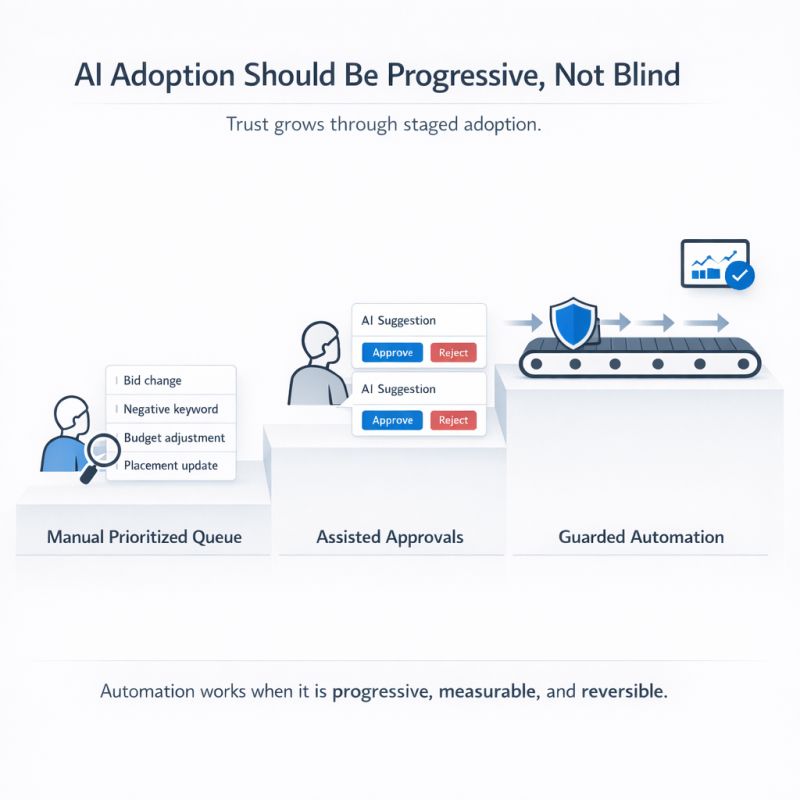
The better model is staged adoption
The stronger approach is progressive automation that earns its way deeper into the workflow.
That often looks like this:
1. Prioritized action queue
Start by helping the team see what matters first.
The system should surface the highest-priority actions in a way managers and analysts can evaluate clearly.
2. Assisted approvals
Next, let the team review and approve actions with context.
This is where the system starts proving whether its reasoning and sequencing are reliable enough to support faster execution.
3. Guarded automation once trust exists
Only after the workflow proves itself should automation expand further.
Even then, it should stay bounded by guardrails, reversibility, and visibility.
What automation should be if agencies are going to trust it
For agencies, automation should be:
- progressive
- measurable
- reversible
Progressive means it expands gradually instead of demanding blind trust up front.
Measurable means the team can evaluate whether it is improving quality, speed, or consistency.
Reversible means the team can recover quickly if something does not behave as expected.
Trust is the real gating factor
Trust does not appear overnight.
It grows when teams stay in control while the system proves itself.
That is the right standard for agency automation.
Not whether the AI sounds impressive.
Whether the workflow becomes easier to trust, easier to defend, and safer to scale.
How Prism is meant to earn trust
Prism is designed around that staged-adoption model.
Instead of asking agencies to hand over control immediately, Prism is built to show the reasoning behind recommendations, support approval-first workflows, and expand automation only when teams are comfortable with the guardrails and outcomes.
That can help agencies:
- adopt automation in stages instead of all at once
- make changes easier to explain to clients and managers
- reduce fear around black-box decision making
- scale execution with more confidence and less operational risk
For agencies
Bring one real review routine. We will map the workflow pressure points.
If this article matches how your team works, the best next step is a workflow teardown. We will look at sequencing, monitoring burden, and what managers need to trust before more automation goes live.
Related posts
Amazon PPC Agency Workflow Evaluation: Increase Accounts Per Manager Without Losing Quality
Many Amazon PPC agencies do not hit a strategy ceiling first. They hit an operational one. Here is what a practical workflow evaluation can look like when you want to scale accounts per manager without degrading delivery quality.
The Review Sequence Amazon PPC Agencies Need Before They Add More Headcount
When agency teams feel stretched, the first fix is usually not more dashboards or more people. It is a better review sequence.
Why Amazon PPC Agencies Need Multi-Account Systems, Not Single-Account Tools
Amazon PPC agencies do not operate inside a single-account dashboard. They operate inside multi-account complexity, where governance and workflow matter more than feature count.