
The Real Amazon PPC Agency Bottleneck Is Execution, Not Analysis
Most PPC tools help teams find ideas faster. Fewer help agencies move those ideas through execution without delay.
Published 2026-03-10 · Updated 2026-03-10
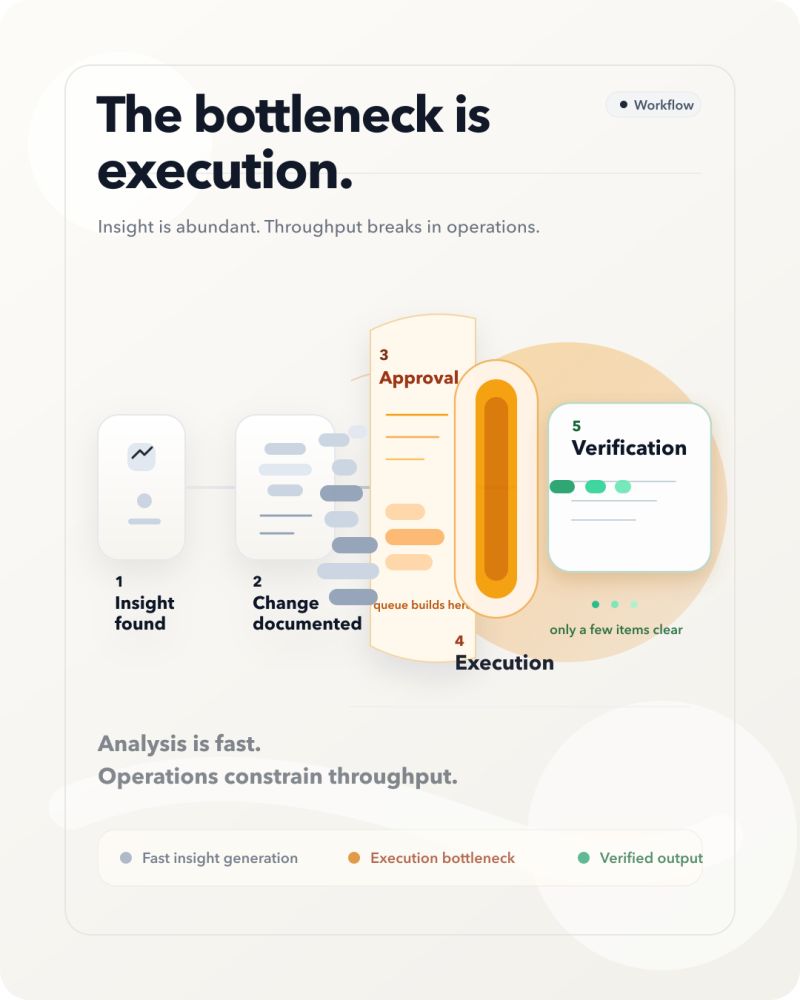
A common Amazon PPC agency workflow looks something like this:
- an analyst finds the insight
- the analyst documents the change
- someone approves it
- someone executes it
- someone verifies it
Every one of those steps can make sense on its own.
But together, they introduce delay.
That delay is what turns good ideas into backlog.
Most teams do not have an insight shortage
Many PPC tools are built to solve the analysis problem first.
They help teams surface recommendations, find anomalies, identify wasted spend, and uncover growth opportunities faster.
That is useful.
But for many agencies, the bigger problem is no longer finding the insight.
It is getting the work through execution without losing momentum.
Where execution starts to break down
The execution bottleneck usually appears when work has to pass through too many sequential handoffs.
An analyst may know exactly what should happen next, but the change still waits:
- for documentation
- for manager approval
- for the execution step
- for confirmation that the work finished correctly
Across one account, that may seem manageable.
Across dozens of accounts, it compounds into slower throughput, slower learning cycles, and less work completed than the team is actually capable of doing.
Why this matters more than people think
When agencies feel strained, they often blame complexity, account count, or team capacity.
Sometimes those are real constraints.
But often the deeper issue is that the workflow does not let execution flow.
That means:
- good recommendations sit too long
- analysts lose time waiting instead of progressing
- managers spend energy on handoff overhead
- the team ends up carrying a growing queue of known work
The issue is not that the team lacks intelligence.
It is that the operating system adds friction at every step.
Speed is not only decision speed
Agencies often talk about moving faster as if the issue were purely about better insight generation.
But speed is not only about making better decisions quickly.
It is about making execution move.
That requires a workflow where insights do not stall between roles, where approvals do not create unnecessary dead time, and where verification does not depend on manual chasing.
The better standard
The best agency systems do not only make recommendations easier to find.
They make it easier for approved work to move from insight to action without unnecessary delay.
That is what real throughput looks like.
Not more ideas sitting in a queue.
More execution flowing through the system.
How Prism is designed to reduce execution drag
Prism is built around that execution layer.
The goal is not just to generate more recommendations. The goal is to help agencies move from insight to approval to action with less handoff friction, better visibility, and more confidence in what is being changed.
That can help teams:
- shorten the delay between insight and execution
- reduce analyst time lost to waiting and follow-up
- improve manager visibility into what is queued, approved, and finished
- increase throughput without immediately adding headcount
For agencies
Bring one real review routine. We will map the workflow pressure points.
If this article matches how your team works, the best next step is a workflow teardown. We will look at sequencing, monitoring burden, and what managers need to trust before more automation goes live.
Related posts
Amazon PPC Agency Workflow Evaluation: Increase Accounts Per Manager Without Losing Quality
Many Amazon PPC agencies do not hit a strategy ceiling first. They hit an operational one. Here is what a practical workflow evaluation can look like when you want to scale accounts per manager without degrading delivery quality.
The Review Sequence Amazon PPC Agencies Need Before They Add More Headcount
When agency teams feel stretched, the first fix is usually not more dashboards or more people. It is a better review sequence.
Why Amazon PPC Agencies Need Multi-Account Systems, Not Single-Account Tools
Amazon PPC agencies do not operate inside a single-account dashboard. They operate inside multi-account complexity, where governance and workflow matter more than feature count.