
Why Amazon PPC Agencies Need Multi-Account Systems, Not Single-Account Tools
Amazon PPC agencies do not operate inside a single-account dashboard. They operate inside multi-account complexity, where governance and workflow matter more than feature count.
Published 2026-03-15 · Updated 2026-03-15
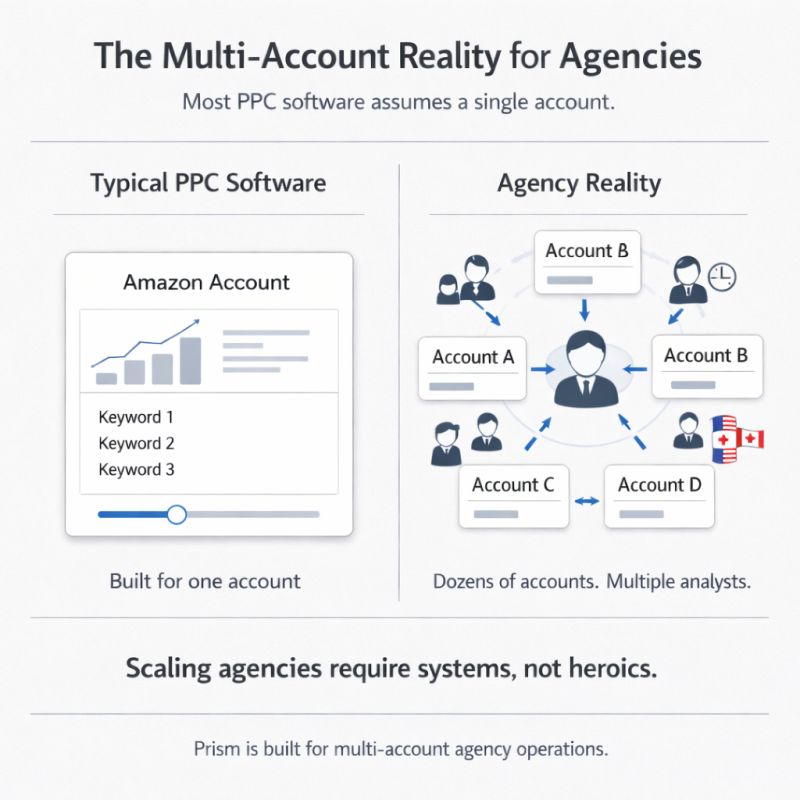
Many Amazon PPC tools are designed around a single-account workflow.
Agencies do not work that way.
They operate inside multi-account complexity every day, where the real challenge is not simply making campaign changes. It is maintaining control across many accounts, many people, and many competing priorities at the same time.
The multi-account reality agencies actually live in
An agency workflow usually means dealing with:
- dozens of advertiser accounts
- multiple marketplaces
- several analysts touching the same campaigns
- different client strategies, constraints, and risk tolerances
That changes the problem completely.
A tool that feels effective inside one account can start breaking down quickly when a team has to coordinate work across an entire book of business.
Why governance starts to matter more than features
Once an agency moves beyond a handful of accounts, governance matters more than another dashboard widget.
The operational questions become:
- Who has access to what?
- Does the team understand the account context before making changes?
- Can managers see what analysts changed and why?
- Is the optimization workflow consistent from one account to the next?
Without that structure, results start depending on individual heroics.
The heroics trap
One great analyst can keep a lot together for a while.
They remember the client nuances. They know where the risk lives. They catch issues early because they have the context in their head.
But that model does not scale.
As the agency grows, the cost of relying on individual heroics gets higher:
- quality becomes inconsistent across accounts
- managers spend more time checking work
- account context becomes fragile
- performance depends too much on who happens to be looking at the account that day
Growth breaks the heroics model because operations become the bottleneck.
What growing agencies actually need
The agencies that scale well usually rely on systems, not heroics.
That means building for:
Team-based access controls
People should see the accounts and actions relevant to their role, without relying on informal coordination to stay aligned.
Clear account context
A team needs to understand client goals, strategy, and risk tolerance before making routine changes. Context should not live only in one person’s memory.
Activity tracking across analysts
Managers need visibility into what changed, who changed it, and how decisions are flowing through the account.
Consistent optimization workflows
A repeatable review and execution sequence makes quality easier to preserve as more accounts and more analysts are added.
Why Prism is built around multi-account execution
This is one of the reasons Prism is being designed around multi-account execution, not just a single-account dashboard.
The agency problem is not only campaign management.
It is operational management:
- preserving review quality under load
- maintaining governance across a team
- improving consistency across accounts
- making optimization easier to trace and defend
Those capabilities are meant to produce practical outcomes for agencies:
- better manager visibility across the book of business
- fewer workflow breakdowns as more analysts touch the same accounts
- more consistent execution from one account to the next
- stronger control as account count rises
That is a different design problem than building another single-account PPC interface.
Agencies do not just manage campaigns
They manage operations.
That is why the strongest agency systems are built around workflow control, governance, and multi-account execution from the start.
If the tool does not match that reality, growth eventually turns into chaos.
For agencies
Bring one real review routine. We will map the workflow pressure points.
If this article matches how your team works, the best next step is a workflow teardown. We will look at sequencing, monitoring burden, and what managers need to trust before more automation goes live.
Related posts
Amazon PPC Agency Workflow Evaluation: Increase Accounts Per Manager Without Losing Quality
Many Amazon PPC agencies do not hit a strategy ceiling first. They hit an operational one. Here is what a practical workflow evaluation can look like when you want to scale accounts per manager without degrading delivery quality.
The Review Sequence Amazon PPC Agencies Need Before They Add More Headcount
When agency teams feel stretched, the first fix is usually not more dashboards or more people. It is a better review sequence.
Why Reversible Automation Matters for Amazon PPC Teams
Teams do not speed up because automation exists. They speed up when automation is safe to reverse.