
Why Reversible Automation Matters for Amazon PPC Teams
Teams do not speed up because automation exists. They speed up when automation is safe to reverse.
Published 2026-03-14 · Updated 2026-03-14
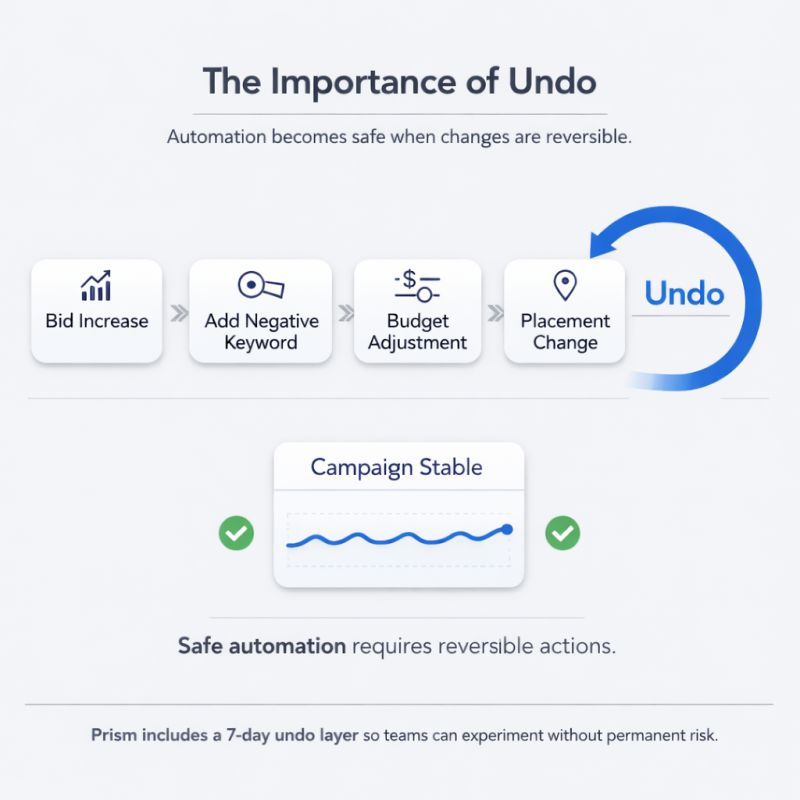
Automation becomes much less scary when every change can be undone.
That sounds simple, but it changes how Amazon PPC teams actually work.
Why teams hesitate around automation
In real accounts, conditions keep changing.
Sometimes performance data shifts unexpectedly. Sometimes a search term behaves differently than expected. Sometimes a strategy that worked last month stops working this month.
That is normal.
The problem is that when automation feels permanent, every action feels riskier than it should.
So teams slow down.
They hesitate.
They avoid experimentation, even when the potential upside is obvious.
What changes when automation is reversible
When supported changes can be rolled back quickly, the psychology changes.
Teams move faster because they know:
- mistakes can be reversed
- tests do not need to become permanent
- experimentation is safer than it looks
That matters because speed does not come only from automation itself. It comes from trust.
And trust is much easier to build when nothing feels irreversible.
Safety is what unlocks speed
Many teams treat safety and speed like tradeoffs.
In practice, safe systems often move faster.
If a team knows it can revert changes quickly, it becomes easier to approve tests, move on recommendations, and try process improvements without worrying that one wrong action will create lasting damage.
That is especially important in agency environments where managers need to protect delivery quality across many accounts at once.
Why we built Prism's 7-day undo layer
This is one reason Prism includes a 7-day undo capability for supported changes.
The point is not just technical recovery. The point is operational confidence.
Reversibility gives teams room to:
- try improvements without fear of permanent damage
- move faster on routine changes
- keep tighter control over experimentation
- maintain trust while expanding automation
Automation works best when teams feel like they can stay in control, even after the change is made.
The better standard for automation
The real question is not only whether a system can make changes automatically.
It is whether the team can use that system confidently under real operating conditions.
That is why reversible automation matters.
The best automation systems do not just optimize faster. They make it safer to learn, safer to test, and safer to improve.
When nothing is irreversible, better teams usually move faster.
What outcomes Prism's undo layer is meant to support
Prism's undo layer is there to create operational confidence, not just a backup feature.
By making supported changes reversible for seven days, Prism helps teams test recommendations, move on routine optimizations faster, and expand automation without feeling locked into every decision.
That can help teams:
- approve changes with less hesitation
- experiment more safely across accounts
- recover faster if a change behaves differently than expected
- build trust in automation without giving up control
For agencies
Bring one real review routine. We will map the workflow pressure points.
If this article matches how your team works, the best next step is a workflow teardown. We will look at sequencing, monitoring burden, and what managers need to trust before more automation goes live.
Related posts
Amazon PPC Agency Workflow Evaluation: Increase Accounts Per Manager Without Losing Quality
Many Amazon PPC agencies do not hit a strategy ceiling first. They hit an operational one. Here is what a practical workflow evaluation can look like when you want to scale accounts per manager without degrading delivery quality.
The Review Sequence Amazon PPC Agencies Need Before They Add More Headcount
When agency teams feel stretched, the first fix is usually not more dashboards or more people. It is a better review sequence.
Why Amazon PPC Agencies Need Multi-Account Systems, Not Single-Account Tools
Amazon PPC agencies do not operate inside a single-account dashboard. They operate inside multi-account complexity, where governance and workflow matter more than feature count.