
The 5-Phase Workflow That Keeps Amazon PPC Teams Consistent
Sequence is what turns busy PPC teams into consistent ones. Without it, work stays flat. With it, execution becomes predictable.
Published 2026-03-09 · Updated 2026-03-09
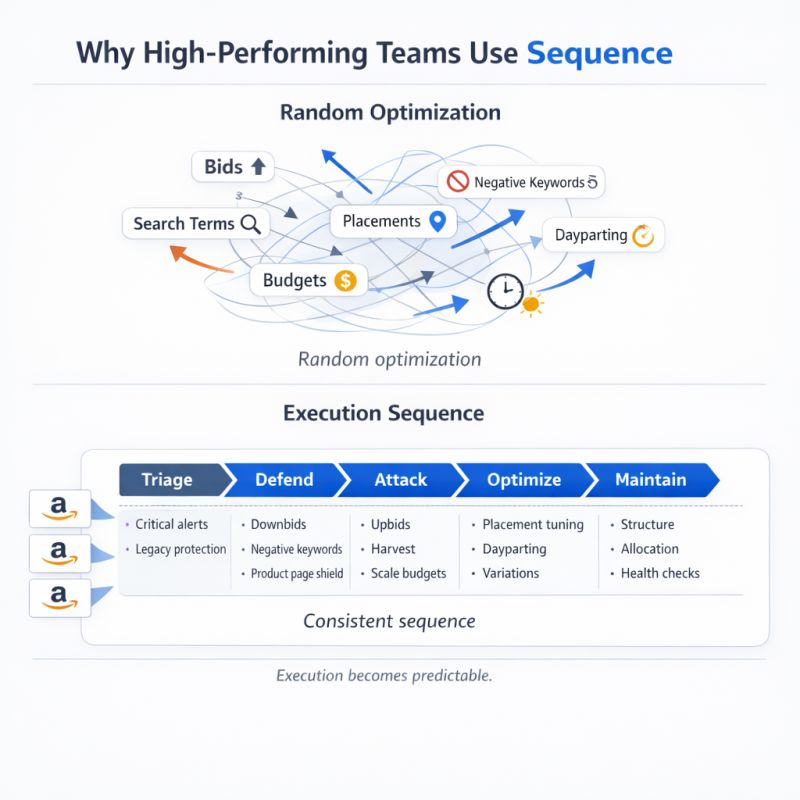
One pattern shows up repeatedly in high-performing Amazon PPC agency teams.
They do not optimize everything randomly.
They follow a consistent sequence.
Why sequence matters more than most teams realize
Many teams work hard but still feel flat.
They are busy, recommendations are being surfaced, and tasks are getting done, but the workflow does not feel predictable. That usually happens when everything sits in one undifferentiated queue.
Without sequence:
- urgent risks compete with routine maintenance
- wasted-spend issues sit beside speculative growth ideas
- deeper optimization work starts before the account is stable
- structural cleanup gets skipped until it becomes painful
The team stays active, but the work loses shape.
The 5-phase workflow
A simple version of the sequence looks like this:
1. Triage
Handle urgent risk first.
This is where the team checks for issues that cannot wait, including anomalies, spend spikes, broken campaign behavior, or anything that could distort performance if left alone.
2. Defend
Control wasted spend second.
Once immediate risk is addressed, the next priority is defending profitability by reducing obvious waste, tightening targeting, and protecting the account from known leakage.
3. Attack
Growth actions follow stability.
Only after the account is no longer reacting to immediate issues should the team push into clear expansion opportunities.
4. Optimize
Deeper optimization comes later.
This is where teams refine performance levers, improve efficiency, and work through adjustments that matter but do not need to happen ahead of triage, defense, or clear attacks.
5. Maintain
Structural cleanup happens last.
Maintenance work is still important. It protects long-term quality. But it usually belongs after the more time-sensitive and leverage-heavy work is already moving.
Why this order works
This sequence works because each stage improves the value of the next one.
If urgent risks are still live, optimization work gets noisier.
If waste is still leaking, growth work becomes less reliable.
If the team starts with maintenance, high-leverage actions sit too long.
Order changes output.
What teams get from a consistent sequence
When teams work in a repeatable order, several things improve:
- managers can review work faster
- analysts know what deserves attention first
- execution becomes easier to predict
- quality becomes less dependent on individual heroics
That is why sequence matters so much for agencies trying to scale account load without losing consistency.
Without sequence, teams stay busy but flat.
With sequence, execution becomes predictable.
How Prism turns that sequence into a working system
Prism is built to help agencies apply this sequence in day-to-day operations.
Instead of leaving triage, defense, growth, and maintenance work buried together, Prism helps teams prioritize the next best actions, keep approval-first control, and maintain visibility as work moves across accounts.
That can help agencies:
- make weekly reviews easier to repeat across analysts
- reduce missed high-priority issues
- improve throughput without losing review quality
- scale a more consistent operating rhythm across the book of business
For agencies
Bring one real review routine. We will map the workflow pressure points.
If this article matches how your team works, the best next step is a workflow teardown. We will look at sequencing, monitoring burden, and what managers need to trust before more automation goes live.
Related posts
Amazon PPC Agency Workflow Evaluation: Increase Accounts Per Manager Without Losing Quality
Many Amazon PPC agencies do not hit a strategy ceiling first. They hit an operational one. Here is what a practical workflow evaluation can look like when you want to scale accounts per manager without degrading delivery quality.
The Review Sequence Amazon PPC Agencies Need Before They Add More Headcount
When agency teams feel stretched, the first fix is usually not more dashboards or more people. It is a better review sequence.
Why Amazon PPC Agencies Need Multi-Account Systems, Not Single-Account Tools
Amazon PPC agencies do not operate inside a single-account dashboard. They operate inside multi-account complexity, where governance and workflow matter more than feature count.