
Why Amazon PPC Agencies Need Systems, Not Hero Operators
Great people matter, but agencies scale more cleanly when systems make performance repeatable instead of relying on heroics.
Published 2026-03-07 · Updated 2026-03-07
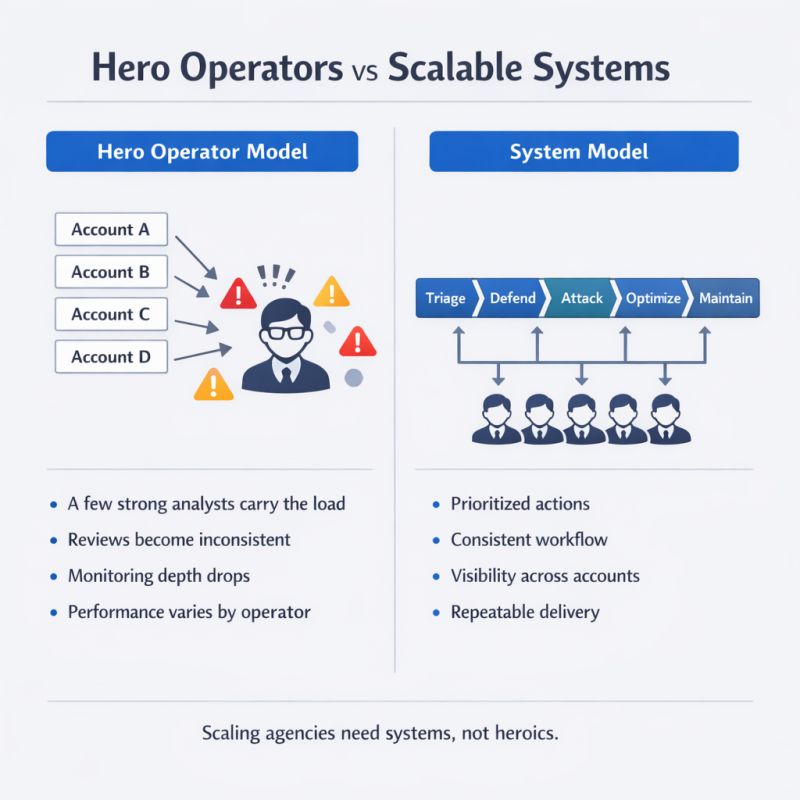
If your Amazon PPC delivery only scales when you hire stronger analysts, you do not have a true scaling system yet.
That does not mean talent is unimportant.
It means the agency is still relying too heavily on individual operators to hold quality together.
What usually breaks first
Most agencies eventually hit the same point.
A few great operators start carrying too much load.
At first, this can look efficient. The strongest people know the accounts deeply, catch issues early, and keep the work moving through sheer competence.
But over time, the strain starts to show:
- reviews become inconsistent
- monitoring depth drops
- small issues compound
- performance varies by operator
That pattern is easy to mistake for a hiring problem.
More often, it is a workflow problem.
Why heroics do not scale cleanly
Hero operators are valuable, but heroics are not a scalable operating model.
If quality depends too much on:
- one manager remembering account nuance
- one analyst spotting the right issue at the right time
- one strong operator compensating for process gaps
then the system itself is still weak.
As the agency grows, those weak points become harder to hide.
What scalable agencies build instead
The agencies that grow cleanly usually build systems around three things.
Prioritization
The team needs a clear way to decide what matters today, not just a growing list of possible optimizations.
Execution cadence
Work has to move through review, approval, and execution in a repeatable rhythm rather than depending on whoever happens to be online and available.
Visibility across accounts
Managers need enough visibility to understand what is happening across the book of business without re-checking everything manually.
Why systems matter even when people are strong
People still matter.
Strong analysts still matter. Strong managers still matter. Good judgment still matters.
But systems are what make performance repeatable.
They reduce dependence on memory, reduce inconsistency between operators, and make it easier for a growing team to preserve quality under load.
That is the difference between scaling people and scaling delivery.
The better goal
The goal is not to remove human judgment.
It is to support it with a workflow that makes strong performance easier to repeat across accounts, across analysts, and across weeks.
That is when agency growth starts to feel durable instead of fragile.
How Prism helps teams move beyond heroics
Prism is built around the idea that strong operators should be supported by a stronger system.
It helps turn scattered account signals into a clearer operating rhythm, makes routine execution easier to control, and gives managers more visibility into what the team is changing and why.
That can help agencies:
- reduce dependence on a few exceptional operators
- make review quality more consistent across analysts
- preserve context and accountability across accounts
- scale delivery with less operational fragility
For agencies
Bring one real review routine. We will map the workflow pressure points.
If this article matches how your team works, the best next step is a workflow teardown. We will look at sequencing, monitoring burden, and what managers need to trust before more automation goes live.
Related posts
Amazon PPC Agency Workflow Evaluation: Increase Accounts Per Manager Without Losing Quality
Many Amazon PPC agencies do not hit a strategy ceiling first. They hit an operational one. Here is what a practical workflow evaluation can look like when you want to scale accounts per manager without degrading delivery quality.
The Review Sequence Amazon PPC Agencies Need Before They Add More Headcount
When agency teams feel stretched, the first fix is usually not more dashboards or more people. It is a better review sequence.
Why Amazon PPC Agencies Need Multi-Account Systems, Not Single-Account Tools
Amazon PPC agencies do not operate inside a single-account dashboard. They operate inside multi-account complexity, where governance and workflow matter more than feature count.