
Why Amazon PPC Agencies Should Buy Outcomes, Not More Features
The real difference is not tool usage. It is whether the system creates delivery leverage for the team.
Published 2026-03-05 · Updated 2026-03-05
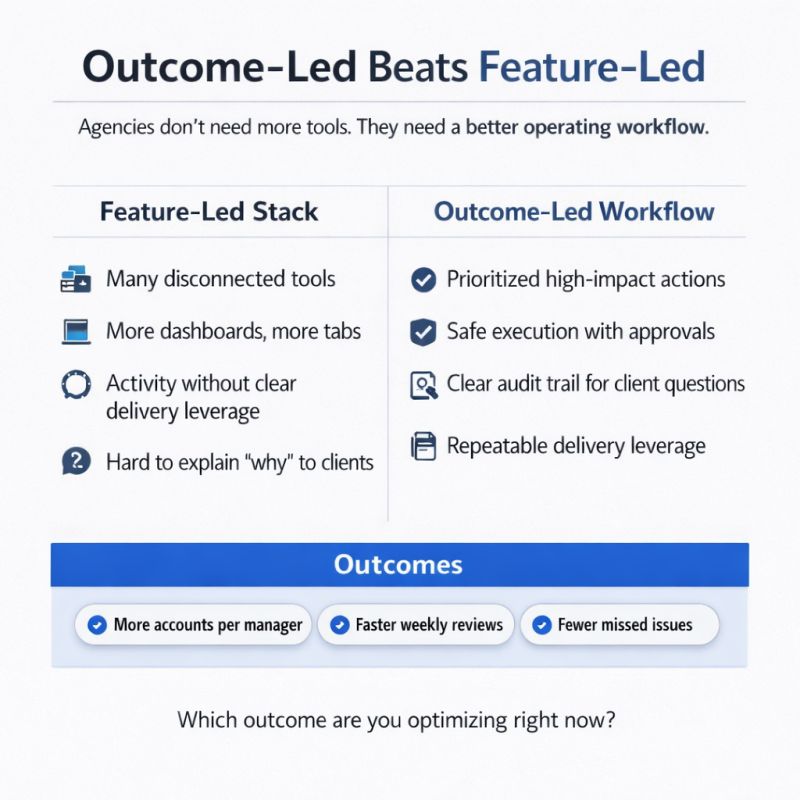
Agencies do not need more Amazon PPC features.
They need a tighter operating system.
That is the difference between using a tool and creating real delivery leverage.
Why feature-led evaluation often misses the real problem
Feature lists are easy to compare.
Teams can ask whether a platform has dashboards, alerts, automations, reporting views, bulk actions, or optimization widgets. Those are all visible and easy to talk about.
But agencies usually do not break because one feature is missing.
They break when the operating system behind delivery is too loose.
What agencies are actually trying to improve
The more useful question is not what features exist.
It is what outcome the team is trying to improve right now.
For many agencies, that means one or more of these:
- more accounts per manager
- faster weekly reviews
- fewer missed issues
Those are operational outcomes, not feature checkboxes.
What a tighter operating system actually does
When agencies improve leverage, it is usually because the system gets better at three things.
Prioritizing high-impact actions
The team needs to know what actually matters today instead of sorting through flat recommendation lists and scattered metrics.
Executing safely
Work has to move from insight to approved action without unnecessary friction, delay, or avoidable risk.
Keeping auditability when clients ask why
Client-facing teams need to explain what changed, why it changed, and how decisions were made. That requires traceability, not just automation.
Tool usage versus delivery leverage
A team can log into a lot of software and still feel operationally constrained.
That is because tool usage is not the same thing as leverage.
Leverage shows up when the system helps the agency:
- move faster without chaos
- preserve quality under load
- make decisions easier to defend
- create more repeatable performance across operators
That is the standard that matters.
The better buying lens
Agencies should evaluate PPC software by asking:
- does this improve accounts per manager?
- does this shorten review cycles?
- does this reduce missed issues?
- does this make the workflow easier to audit and defend?
If the answer is no, then the feature list probably does not matter very much.
The right system is not the one with the longest list.
It is the one that improves the operating outcome the team cares about most.
Why Prism is positioned around outcomes
This is why Prism is not being positioned as another feature-heavy PPC dashboard.
Prism is built around the operational outcomes agencies actually care about: clearer prioritization, faster execution of routine changes, stronger auditability, and more control as account complexity rises.
That helps teams pursue outcomes like:
- more accounts per manager
- faster weekly review cycles
- fewer missed issues
- safer automation that managers can defend
For agencies
Bring one real review routine. We will map the workflow pressure points.
If this article matches how your team works, the best next step is a workflow teardown. We will look at sequencing, monitoring burden, and what managers need to trust before more automation goes live.
Related posts
Amazon PPC Agency Workflow Evaluation: Increase Accounts Per Manager Without Losing Quality
Many Amazon PPC agencies do not hit a strategy ceiling first. They hit an operational one. Here is what a practical workflow evaluation can look like when you want to scale accounts per manager without degrading delivery quality.
The Review Sequence Amazon PPC Agencies Need Before They Add More Headcount
When agency teams feel stretched, the first fix is usually not more dashboards or more people. It is a better review sequence.
Why Amazon PPC Agencies Need Multi-Account Systems, Not Single-Account Tools
Amazon PPC agencies do not operate inside a single-account dashboard. They operate inside multi-account complexity, where governance and workflow matter more than feature count.