
How Amazon PPC Agencies Can Diagnose the Real Bottleneck
Before adding headcount, agencies should separate bandwidth problems from workflow noise and execution friction.
Published 2026-03-04 · Updated 2026-03-04
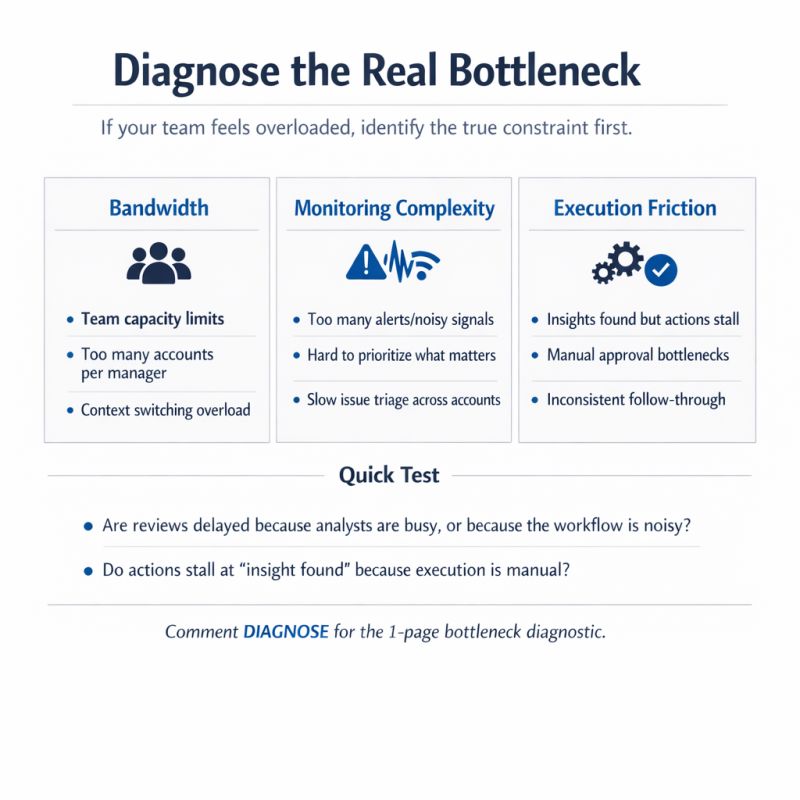
If your Amazon PPC team feels overloaded, the first step is to separate the bottleneck correctly.
In many agencies, the real constraint is not what people assume it is.
The three bottlenecks worth separating
When delivery starts to feel strained, the pressure usually comes from one of three places:
- bandwidth
- monitoring complexity
- execution friction
The problem is that many agencies mislabel the second and third as the first.
That leads teams to assume they need more people when the real issue is that the workflow itself is too noisy or too slow.
Bandwidth versus complexity versus friction
These are not the same problem.
Bandwidth
This is the straightforward case.
The team genuinely does not have enough capacity for the account load, even if the workflow is clean and execution is working smoothly.
Monitoring complexity
This happens when the review burden is too heavy.
Analysts spend too much time scanning, interpreting, and figuring out what matters before they can even begin acting. The issue is not only the quantity of work. It is the cost of finding the work.
Execution friction
This happens when good actions get discovered but stall before they turn into changes.
Approvals, documentation, handoffs, or manual execution steps slow the system down after the insight already exists.
A quick diagnostic
If you are trying to figure out which problem you actually have, start with two questions.
Are reviews delayed because analysts are busy, or because the workflow is noisy?
If the team spends most of its time sorting through scattered signals, context switching, and deciding where to start, the constraint may be monitoring complexity rather than raw staffing.
Do actions stall at “insight found” because execution is still manual?
If good recommendations sit in backlog after they are already known, the real issue may be execution friction.
Why agencies get this wrong
It is easy to look at a strained team and conclude that the problem is headcount.
But adding people does not automatically fix:
- weak review sequence
- noisy monitoring surfaces
- approval bottlenecks
- slow execution handoffs
If the workflow is inefficient, adding people can simply scale the mess.
The better sequence
Before adding capacity, agencies should ask:
- is the team struggling to find what matters?
- is the team struggling to move known work through execution?
- or is the team actually out of capacity after those issues are controlled?
That order matters because it helps separate workflow design problems from true staffing limits.
What a good diagnostic should do
A useful bottleneck diagnostic should not just tell you the team feels overloaded.
It should help you identify whether the real constraint is:
- too much account load
- too much monitoring complexity
- too much execution friction
Once that is clear, the fix becomes much more obvious.
Where Prism fits in
Prism is designed to help agencies separate these bottlenecks in a more practical way.
Instead of forcing the team to hunt through scattered signals and then hand off work through a slow chain, Prism is built to surface what matters, explain why it matters, and support safer execution with more control.
In practice, that means agencies can use Prism to:
- identify whether the real issue is monitoring burden or execution friction
- reduce time lost to scanning and context switching
- move approved work forward faster
- preserve review quality as account load grows
For agencies
Bring one real review routine. We will map the workflow pressure points.
If this article matches how your team works, the best next step is a workflow teardown. We will look at sequencing, monitoring burden, and what managers need to trust before more automation goes live.
Related posts
Amazon PPC Agency Workflow Evaluation: Increase Accounts Per Manager Without Losing Quality
Many Amazon PPC agencies do not hit a strategy ceiling first. They hit an operational one. Here is what a practical workflow evaluation can look like when you want to scale accounts per manager without degrading delivery quality.
The Review Sequence Amazon PPC Agencies Need Before They Add More Headcount
When agency teams feel stretched, the first fix is usually not more dashboards or more people. It is a better review sequence.
Why Amazon PPC Agencies Need Multi-Account Systems, Not Single-Account Tools
Amazon PPC agencies do not operate inside a single-account dashboard. They operate inside multi-account complexity, where governance and workflow matter more than feature count.