
The Capacity Ceiling Most Amazon PPC Agencies Hit First
When one manager is carrying too many accounts, the first losses usually show up in waste control, review cadence, and reactive firefighting.
Published 2026-03-03 · Updated 2026-03-03
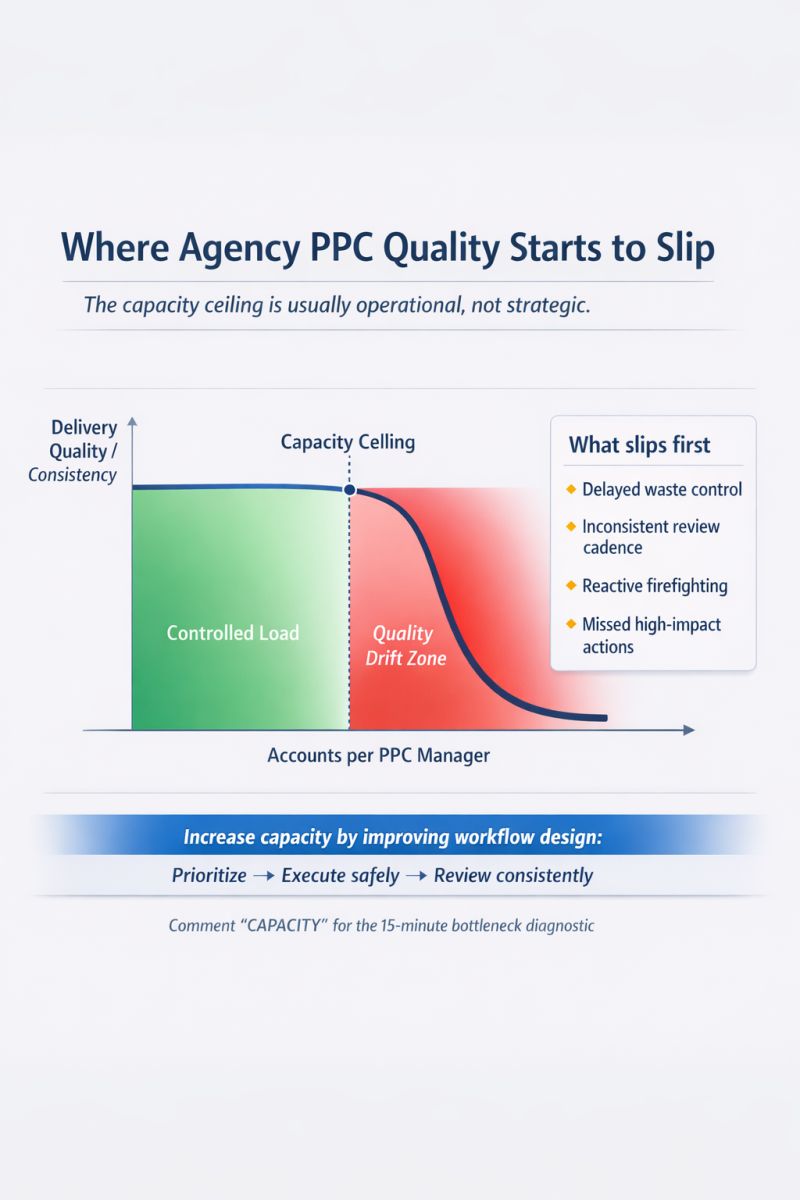
Most Amazon PPC agencies do not hit a strategy ceiling first.
They hit an operator capacity ceiling.
That is an important distinction because it changes how the problem should be diagnosed and how the solution should be designed.
What the capacity ceiling actually looks like
When one manager is juggling too many accounts, quality usually starts to drift in predictable places.
The first signs often include:
- delayed waste control
- inconsistent review cadence
- reactive firefighting
The team may still be highly capable. The issue is that the operating load has grown beyond what the current workflow can support cleanly.
Why this is not mainly a strategy problem
At this stage, agencies often already know what good account management looks like.
The challenge is not a lack of strategic knowledge.
The challenge is preserving review quality as more accounts, more context, and more recurring checks stack onto the same manager or team.
That is why the question is not simply:
How do we work harder?
The better question is:
How do we increase account capacity without adding headcount first?
Where quality usually slips first
Capacity strain tends to show up in operational patterns before it shows up in obvious strategic failure.
For example:
Delayed waste control
Known issues sit too long because the team does not reach them early enough in the cycle.
Inconsistent review cadence
Accounts stop getting reviewed with the same depth or frequency because the weekly workflow gets compressed.
Reactive firefighting
The team spends more time responding to what broke than working through a controlled, repeatable review sequence.
Why headcount is not always the first fix
Adding people can help, but it is not always the first lever to pull.
If the workflow itself is noisy, flat, or slow, new headcount may simply inherit the same constraints.
Before expanding the team, agencies often get more leverage by tightening:
- prioritization
- execution flow
- manager visibility
- review structure
That is what can increase effective capacity before the org chart changes.
How Prism helps agencies raise capacity safely
Prism is built for this exact operational problem.
Instead of adding another flat dashboard, Prism helps agency teams turn account complexity into a clearer weekly workflow with prioritized actions, approval-first execution, and manager visibility across accounts.
That can help agencies:
- increase accounts per manager without letting review quality drift
- shorten time spent scanning for what matters first
- reduce missed waste-control and maintenance work
- keep changes easier to explain internally and to clients
The better diagnostic
If increasing account capacity is a priority, the most useful question is not whether the team feels busy.
It is where the workflow is breaking first.
Is the issue:
- too much scanning before judgment?
- too much delay between insight and execution?
- too little consistency in review order?
Once that becomes clear, the path forward gets much easier to define.
That is how agencies separate a true staffing limit from an operating-system problem.
For agencies
Bring one real review routine. We will map the workflow pressure points.
If this article matches how your team works, the best next step is a workflow teardown. We will look at sequencing, monitoring burden, and what managers need to trust before more automation goes live.
Related posts
Amazon PPC Agency Workflow Evaluation: Increase Accounts Per Manager Without Losing Quality
Many Amazon PPC agencies do not hit a strategy ceiling first. They hit an operational one. Here is what a practical workflow evaluation can look like when you want to scale accounts per manager without degrading delivery quality.
The Review Sequence Amazon PPC Agencies Need Before They Add More Headcount
When agency teams feel stretched, the first fix is usually not more dashboards or more people. It is a better review sequence.
Why Amazon PPC Agencies Need Multi-Account Systems, Not Single-Account Tools
Amazon PPC agencies do not operate inside a single-account dashboard. They operate inside multi-account complexity, where governance and workflow matter more than feature count.