
Why Amazon PPC Automation Needs Guardrails Before It Scales
The real test for automation is not whether it can act. It is whether a team can trust it under real operating conditions.
Published 2026-03-13 · Updated 2026-03-13
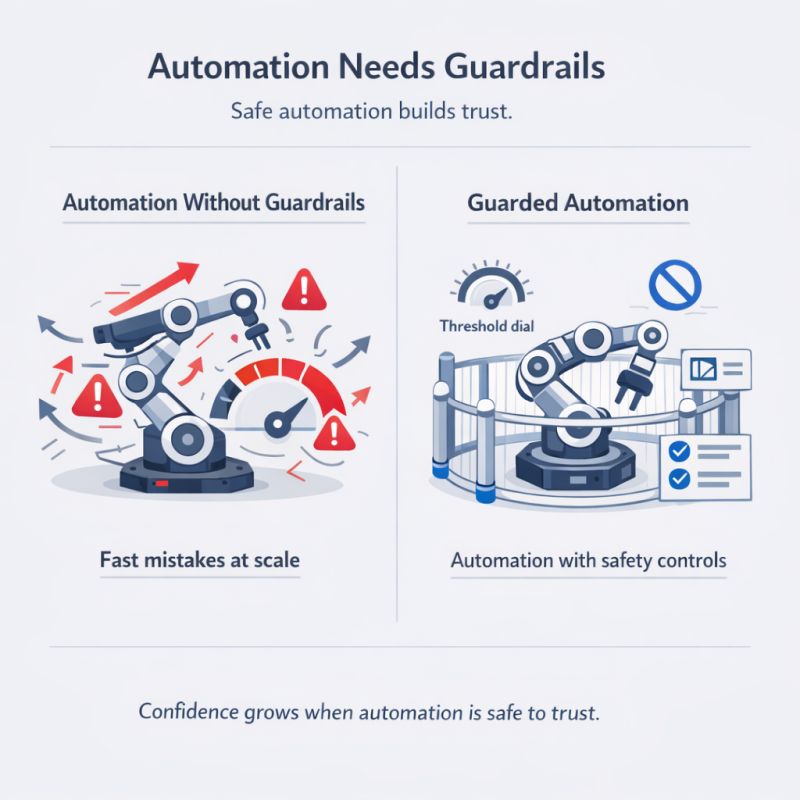
Automation without guardrails does not reliably save time.
It can just create faster mistakes.
That is especially true in Amazon PPC, where one unchecked rule can change spend, structure, and performance across a large set of campaigns much faster than a team can manually recover.
What can go wrong without guardrails
In a live account, a single uncontrolled automation path can:
- spike bids across hundreds of keywords
- drain budgets in a few hours
- break a campaign structure that took months to tune
That is why the automation question is not only about efficiency.
It is about safety.
What responsible automation actually needs
If a team wants automation to be useful in production, the system needs controls around it.
That usually includes:
Thresholds before actions trigger
Automation should not act on weak or noisy signals. Teams need rules around when a change is allowed to fire at all.
Exclusions for sensitive campaigns
Some campaigns, client accounts, or strategic initiatives should stay outside automated change scopes unless a manager explicitly decides otherwise.
Circuit breakers if performance drifts
If performance moves outside expected bounds, the system should slow down or stop rather than keep applying the same logic.
Visibility into what changed and why
Managers and analysts need to understand the reasoning behind changes so they can evaluate whether the workflow is working as intended.
Why the best teams expand automation gradually
The strongest teams do not jump from manual execution straight to full automation.
They usually expand trust in stages:
- start with human review
- allow assisted execution
- enable automation after accuracy proves itself
That progression matters because confidence does not come from AI promises.
It comes from experience with a system that behaves safely and predictably.
Safe automation is what makes scale possible
Teams do not need more automation in the abstract.
They need automation that is safe to trust under real account conditions, across real client risk tolerances, and inside real review workflows.
That is what guardrails are for.
The goal is not just moving faster.
The goal is moving faster without losing control.
That is the standard responsible automation should meet.
How Prism approaches guarded automation
Prism is designed around that standard.
The system is built to pair automation with clear reasoning, approval-first controls, and safeguards that help teams expand trust gradually instead of taking unnecessary operational risk.
That can help teams:
- automate routine work without losing visibility
- protect sensitive campaigns and clients with clearer controls
- reduce the chance of scaling mistakes
- move faster while keeping managers confident in what is happening
For agencies
Bring one real review routine. We will map the workflow pressure points.
If this article matches how your team works, the best next step is a workflow teardown. We will look at sequencing, monitoring burden, and what managers need to trust before more automation goes live.
Related posts
Amazon PPC Agency Workflow Evaluation: Increase Accounts Per Manager Without Losing Quality
Many Amazon PPC agencies do not hit a strategy ceiling first. They hit an operational one. Here is what a practical workflow evaluation can look like when you want to scale accounts per manager without degrading delivery quality.
The Review Sequence Amazon PPC Agencies Need Before They Add More Headcount
When agency teams feel stretched, the first fix is usually not more dashboards or more people. It is a better review sequence.
Why Amazon PPC Agencies Need Multi-Account Systems, Not Single-Account Tools
Amazon PPC agencies do not operate inside a single-account dashboard. They operate inside multi-account complexity, where governance and workflow matter more than feature count.