
Why Async Approvals Increase Throughput for Amazon PPC Agencies
Most agency throughput problems are not talent problems. They are workflow design problems, and approvals are often where the bottleneck starts.
Published 2026-03-11 · Updated 2026-03-11
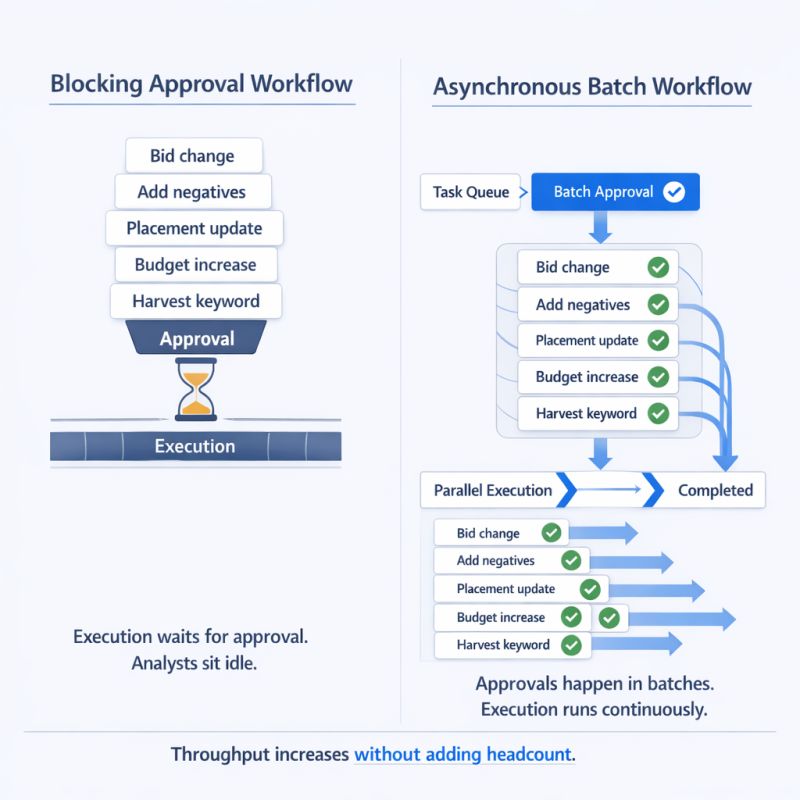
A lot of Amazon PPC agencies accidentally create their own execution bottleneck.
Usually it is not because analysts are slow.
It is because approvals are treated like a blocking step.
How the bottleneck usually gets created
The common workflow looks like this:
- an analyst identifies actions
- submits them for approval
- waits for execution
- then moves to the next account
That might feel reasonable in one account.
But multiply it across dozens of accounts and a more subtle problem appears.
Execution becomes the bottleneck.
Why waiting kills throughput
When approvals and execution are tightly chained together, analysts lose momentum.
Instead of continuing to make progress across the book of business, they end up pausing behind a queue that does not actually require their full attention.
That creates several downstream problems:
- slower account coverage
- more context switching
- less work completed per manager or analyst
- unnecessary pressure to add headcount before improving workflow design
The team can look busy while the system itself stays slow.
The workflow shift that changes the math
A small operational change can improve throughput meaningfully.
Instead of forcing analysts to wait on each approval cycle, agencies can:
- queue actions
- approve in batches
- process changes asynchronously
- track completion in real time
Now the team is no longer coupling analysis time directly to execution time.
That matters because the analyst's highest-value work is judgment, prioritization, and review, not sitting in a holding pattern while routine changes finish processing.
What async approvals actually improve
Async approvals do not only speed up one task.
They improve the overall operating rhythm of the team.
That can mean:
More continuous analyst flow
Analysts can continue reviewing the next account instead of waiting for the current account's execution step to clear.
Better batching by managers
Managers can approve work in grouped sessions instead of constantly interrupting themselves for one-off decisions.
Clearer operational visibility
When completion is tracked in real time, teams can see what is queued, what is approved, and what is finished without relying on manual follow-up.
Most throughput problems are workflow problems
When an agency starts feeling operational strain, the first assumption is often that the team needs more people.
Sometimes that is true.
But often the bottleneck is not talent. It is workflow design.
If approvals are blocking work instead of enabling it, the system is forcing people to move slower than they need to.
That is why async approvals matter.
They help agencies increase throughput without immediately increasing headcount, simply by letting the work keep moving.
How Prism supports async approval workflows
Prism is designed to help agencies keep that work moving without giving up control.
It gives teams a way to review prioritized actions, approve work in a more practical rhythm, and maintain visibility into what has been queued, executed, or completed across accounts.
That can help agencies:
- keep analysts focused on judgment instead of waiting
- make manager approvals easier to batch
- reduce status-chasing across the team
- increase throughput while keeping execution easier to audit
For agencies
Bring one real review routine. We will map the workflow pressure points.
If this article matches how your team works, the best next step is a workflow teardown. We will look at sequencing, monitoring burden, and what managers need to trust before more automation goes live.
Related posts
Amazon PPC Agency Workflow Evaluation: Increase Accounts Per Manager Without Losing Quality
Many Amazon PPC agencies do not hit a strategy ceiling first. They hit an operational one. Here is what a practical workflow evaluation can look like when you want to scale accounts per manager without degrading delivery quality.
The Review Sequence Amazon PPC Agencies Need Before They Add More Headcount
When agency teams feel stretched, the first fix is usually not more dashboards or more people. It is a better review sequence.
Why Amazon PPC Agencies Need Multi-Account Systems, Not Single-Account Tools
Amazon PPC agencies do not operate inside a single-account dashboard. They operate inside multi-account complexity, where governance and workflow matter more than feature count.