
Amazon PPC Agency Workflow Evaluation: Increase Accounts Per Manager Without Losing Quality
Many Amazon PPC agencies do not hit a strategy ceiling first. They hit an operational one. Here is what a practical workflow evaluation can look like when you want to scale accounts per manager without degrading delivery quality.
Published 2026-03-16 · Updated 2026-03-16
Quick Answer
A practical Amazon PPC agency workflow evaluation should measure whether better prioritization, faster execution, and controlled automation let managers handle more accounts without losing review quality.
Key Takeaways
- Better sequence matters before more headcount
- Faster execution only helps when review quality stays visible
- Automation needs guardrails and traceability
- Workflow evaluations should measure accounts per manager without sacrificing delivery quality
Many Amazon PPC agencies eventually hit a similar ceiling.
It is not usually a strategy problem. It is an operational one.
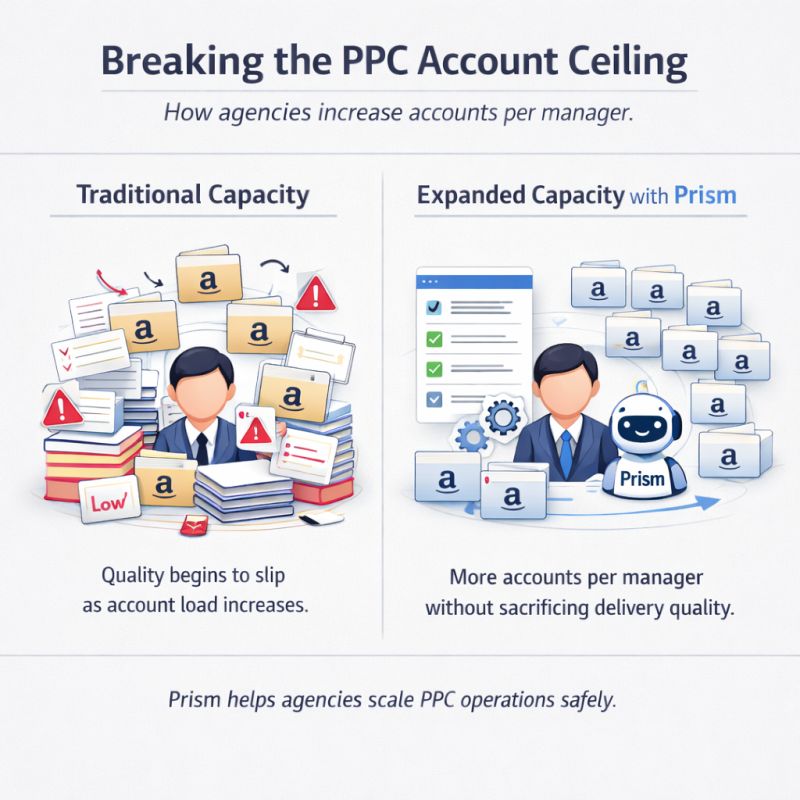
A strong manager can only hold so many accounts before review quality starts to slip. Monitoring gets shallower. Priorities get fuzzier. Routine but important checks get delayed. The team still stays busy, but confidence in the work starts to erode.
That is the real scaling question for agencies:
How do you increase accounts per manager without burning out the team or degrading performance?
The agencies that handle this well usually do not solve it by simply pushing people to work harder.
They solve it by improving the operating system behind the work.
The three levers that matter most
When agencies successfully raise accounts per manager, they usually improve three things first.
1. Clear prioritization of work
Most account teams do not need more recommendations. They need a better sequence.
If urgent risks, waste-control tasks, growth opportunities, and maintenance work all sit in the same flat queue, the week gets consumed by motion instead of leverage. Better prioritization means the team can see what deserves attention first and why.
2. Faster execution of routine changes
A large share of account management work is not intellectually difficult. It is repetitive.
The problem is that repetitive work still absorbs time and attention. If teams can execute the routine changes faster, they create more room for judgment, client context, and higher-value analysis.
3. Automation with guardrails and traceability
Automation only helps if managers can trust it.
That means clear guardrails, clear reasoning, and clear visibility into what changed. Black-box automation may save time in the short term, but it usually creates a control problem later. Agencies need systems they can defend internally and to clients.
What we are building Prism around
That is exactly the problem Prism is designed to help solve.
Prism is not meant to replace analysts. It is meant to help agencies scale the work they already do by improving how the work gets prioritized, executed, and reviewed.
In practical terms, that means helping teams:
- prioritize the right actions
- execute routine changes faster
- maintain full visibility and control
The outcomes we care about are operational, not cosmetic:
- more accounts per manager
- faster weekly reviews
- fewer missed issues under load
- more confidence in what the team is changing and why
The goal is not more automation in the abstract.
The goal is increasing accounts per manager without sacrificing delivery quality.
Opening a small number of agency workflow evaluations
I am working with a small number of agencies on structured workflow evaluations to measure Prism inside real account workflows.
The format is simple:
- a 30-day evaluation
- a small set of accounts
- a clear before-and-after comparison
No long contracts.
Just a practical way to test whether a better workflow system can help your team increase accounts per manager without creating more burnout or more delivery risk.
Who this workflow evaluation is best for
This is a strong fit if:
- your agency already has solid PPC expertise
- the strain is showing up in workflow, not in basic strategy knowledge
- managers feel review complexity increasing across accounts
- you want more control and consistency before expanding automation further
The question worth testing
For most agencies, the real question is not whether automation can make some changes faster.
It is whether the team can preserve quality as complexity grows.
That is the standard we care about in these workflow evaluations.
If that is the problem your team is trying to solve, the best next step is to walk through one real review routine and see where the load is breaking it today.
Sources
For agencies
Bring one real review routine. We will map the workflow pressure points.
If this article matches how your team works, the best next step is a workflow teardown. We will look at sequencing, monitoring burden, and what managers need to trust before more automation goes live.
Related posts
The Review Sequence Amazon PPC Agencies Need Before They Add More Headcount
When agency teams feel stretched, the first fix is usually not more dashboards or more people. It is a better review sequence.
Why Amazon PPC Agencies Need Multi-Account Systems, Not Single-Account Tools
Amazon PPC agencies do not operate inside a single-account dashboard. They operate inside multi-account complexity, where governance and workflow matter more than feature count.
Why Reversible Automation Matters for Amazon PPC Teams
Teams do not speed up because automation exists. They speed up when automation is safe to reverse.