
A 5-Phase Weekly Operating Rhythm for Amazon PPC Agencies
High-performing PPC teams do not just work hard every week. They follow a rhythm that gives the work shape.
Published 2026-03-06 · Updated 2026-03-06
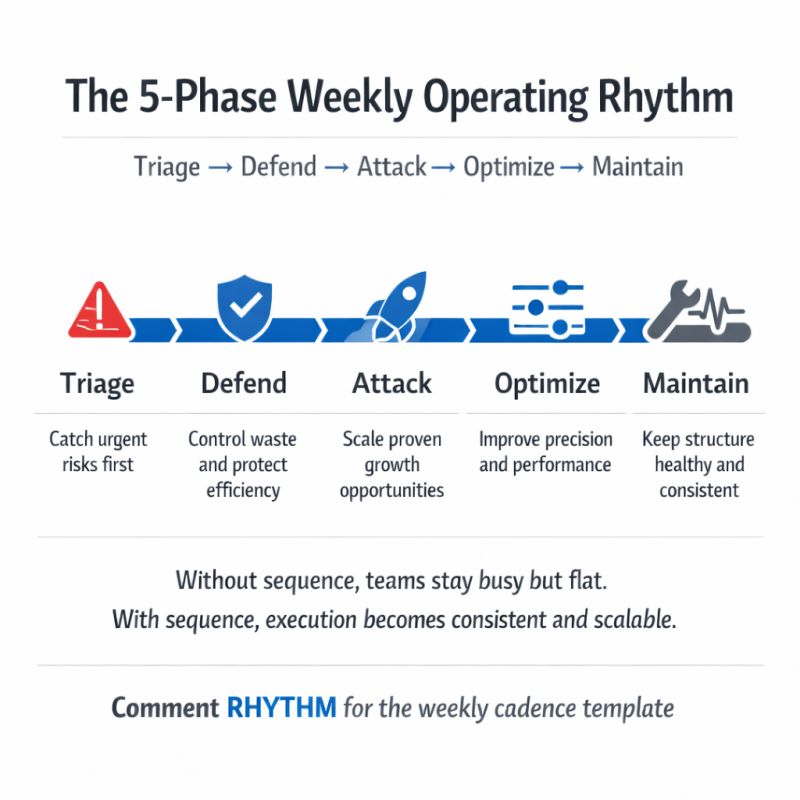
A practical Amazon PPC agency workflow often follows a simple sequence:
Triage -> Defend -> Attack -> Optimize -> Maintain
That order gives the week structure.
Without structure, teams can stay active while still feeling flat. Work gets done, but it becomes harder to tell whether the highest-leverage actions were handled in the right order.
Why this sequence works
Each phase solves a different job, and the order matters.
Triage
Urgent risk comes first.
This is where the team checks for anomalies, spend spikes, broken campaign behavior, or anything that could distort performance if left untouched.
Defend
Waste control comes second.
Once immediate risk is contained, the next priority is protecting the account from obvious leakage and preserving stability.
Attack
Growth actions come after stability.
Expansion work matters more once the account is not actively reacting to urgent issues or avoidable waste.
Optimize
Deeper refinement comes later.
This is where teams improve efficiency and work through changes that matter, but do not need to happen ahead of triage, defense, or clear growth actions.
Maintain
Structural hygiene comes last.
Cleanup, organization, and recurring maintenance still matter. They are just usually lower in urgency than the earlier phases.
What happens without a weekly rhythm
Without sequence, teams often operate from a flat task list.
That leads to familiar problems:
- urgent work gets mixed with low-priority work
- analysts switch contexts too often
- managers have a harder time reviewing consistently
- quality depends too much on individual operator judgment
The team stays moving, but the work loses shape.
Why a rhythm helps agencies scale
A weekly operating rhythm does more than organize one review session.
It helps agencies:
- make prioritization more repeatable
- improve consistency across analysts
- review accounts in a more predictable order
- preserve quality as account load grows
That is why sequence matters so much in agency delivery.
It turns activity into a workflow.
The better standard
High-performing PPC teams do not just optimize harder.
They follow a rhythm that makes execution easier to repeat week after week.
That is what gives the work more control, more consistency, and more predictability.
How Prism supports that weekly rhythm
Prism is designed to help agencies operationalize this kind of review sequence.
Instead of leaving triage, waste control, growth actions, and maintenance in one flat queue, Prism is built to make the next best action clearer, keep approvals easier to manage, and preserve control as teams scale account load.
That can help agencies:
- review accounts in a more consistent order
- reduce time lost to context switching
- improve manager oversight without re-checking everything manually
- increase throughput without sacrificing delivery quality
For agencies
Bring one real review routine. We will map the workflow pressure points.
If this article matches how your team works, the best next step is a workflow teardown. We will look at sequencing, monitoring burden, and what managers need to trust before more automation goes live.
Related posts
Amazon PPC Agency Workflow Evaluation: Increase Accounts Per Manager Without Losing Quality
Many Amazon PPC agencies do not hit a strategy ceiling first. They hit an operational one. Here is what a practical workflow evaluation can look like when you want to scale accounts per manager without degrading delivery quality.
The Review Sequence Amazon PPC Agencies Need Before They Add More Headcount
When agency teams feel stretched, the first fix is usually not more dashboards or more people. It is a better review sequence.
Why Amazon PPC Agencies Need Multi-Account Systems, Not Single-Account Tools
Amazon PPC agencies do not operate inside a single-account dashboard. They operate inside multi-account complexity, where governance and workflow matter more than feature count.